
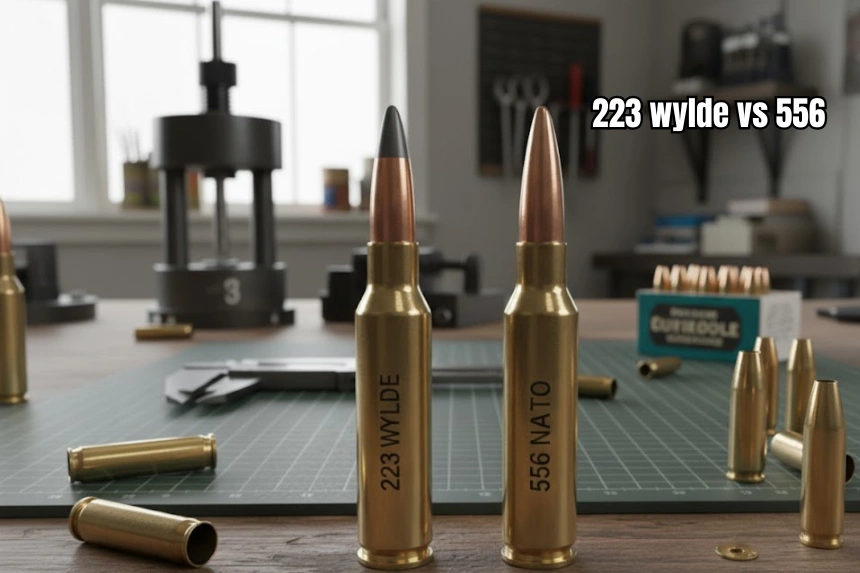
The debate between .223 Wylde and 5.56 NATO chambers is a common one among AR-15 enthusiasts, competitive shooters, and anyone interested in maximizing precision and safety from their rifle. With so many opinions and technical details floating around, it’s easy to get confused. This article will break down the key differences, examine the practical implications, and guide you toward the best choice for your needs.
What Are .223 Wylde and 5.56 NATO Chambers?
The 5.56 NATO Chamber
The 5.56 NATO chamber (named after the 5.56x45mm NATO military cartridge) is the standard for military rifles worldwide. These chambers are designed to safely fire higher-pressure 5.56 NATO rounds, and they can also shoot lower-pressure .223 Remington ammunition. However, firing 5.56 NATO rounds in a rifle chambered only for .223 Remington can be dangerous due to higher pressures produced by 5.56 NATO ammo.
The .223 Wylde Chamber
The .223 Wylde chamber is a hybrid design, developed to allow shooters to safely and accurately fire both .223 Remington and 5.56 NATO cartridges. It blends the best features of the .223 Remington and 5.56 NATO chambers, offering excellent reliability and accuracy for both types of ammunition.
Why Does Chambering Matter?
Chamber design impacts three vital elements:
Safety: Firing the wrong ammunition in an unsuitable chamber can result in pressure-related malfunctions or even catastrophic failure.
Accuracy: The subtle differences in chamber dimensions and throat geometry can significantly influence the rifle’s accuracy with different ammo types.
Compatibility: Some shooters want the ability to use both civilian and military ammunition interchangeably.
Key Differences Between .223 Wylde and 5.56
| Feature | 5.56 NATO | .223 Wylde |
| Ammo Use | 5.56 & .223* | 5.56 & .223 |
| Pressure Safe | Designed for 5.56 | Designed for both |
| Accuracy | Good with 5.56 | Excellent with both |
| Leade/Throat | Longer, looser | Optimized hybrid |
| Safety Margin | Higher for 5.56 | Optimal for both |
| Chamber Tolerance | Looser | Tighter, precision-cut |
Technically, you can shoot .223 in a 5.56 chamber, but may lose a bit of accuracy compared to a .223 or Wylde chamber .
Advantages and Disadvantages
5.56 NATO Chamber
| Advantages | Disadvantages |
| Robust and tolerant of varied ammunition | Slightly looser tolerances can compromise maximum accuracy, especially with .223 Remington match-grade ammo |
| Designed for high-pressure military 5.56 NATO cartridges | Not optimized for the intricacies of both ammo types |
| Reliable under rugged conditions | — |
.223 Wylde Chamber
| Advantages | Disadvantages |
| Robust and tolerant of varied ammunition | Slightly looser tolerances can compromise maximum accuracy, especially with .223 Remington match-grade ammo |
| Designed for high-pressure military 5.56 NATO cartridges | Not optimized for the intricacies of both ammo types |
| Reliable under rugged conditions | — |
Performance and Accuracy
One of the strongest arguments for .223 Wylde is its performance. The hybrid design of the Wylde chamber leverages a throat and leade geometry that tightens up the fit for .223 Remington ammunition (like a match chamber) while still handling the higher pressures of 5.56 NATO rounds without issue.
Numerous shooters and experts report that rifles with .223 Wylde chambers outperform standard 5.56 chambers in terms of raw accuracy, especially when using high-quality .223 ammunition. However, factors such as barrel quality, bolt trueness, and ammo consistency still play huge roles in ultimate accuracy.
Safety and Compatibility
Never fire 5.56 NATO ammunition in a rifle chambered strictly for .223 Remington. This can create dangerous overpressure situations. However, .223 Wylde chambers are specifically designed to handle both safely, making them a superior choice for shooters who want flexibility without sacrificing safety.
The Debate: Is There Any Downside to Choosing .223 Wylde?
The broad consensus among AR-15 community members and experts is that there is little reason not to select a .223 Wylde chamber, unless you are working within a very specific budget or sourcing an unusual rifle configuration. In practical terms, the .223 Wylde chamber is a smart upgrade for most shooters and introduces only slight cost or supply considerations.
Real-World Use: Who Should Choose What?
Hobby Shooters & Plinkers: Either chamber will perform well, but Wylde offers more flexibility if you want to experiment with different ammo types.
Competitors & Long-Range Shooters: .223 Wylde provides the accuracy edge needed for precision shooting.
Tactical/Military Applications: 5.56 is rugged and proven, but many operators now opt for Wylde for its reliability and versatility.
Hunters: If your state’s regulations allow either, Wylde lets you run whichever ammo you find most effective.
So… Which Is Ultimately Better?
The debate of 223 Wylde vs 5.56 comes down to your priorities, accuracy, reliability, or versatility. The 223 Wylde chamber was created to bridge the gap between precision and function, and for most modern AR-15 owners, it delivers the best overall performance.
Whether you’re a new AR-15 builder or an experienced shooter seeking the perfect chamber, understanding these differences ensures you pick the right setup for your intended use, and get the most out of your firearm.
Conclusion:
The debate of 223 Wylde vs 5.56 comes down to your priorities—accuracy, reliability, or versatility. The 223 Wylde chamber was created to bridge the gap between precision and function, and for most modern AR-15 owners, it delivers the best overall performance.
Whether you’re a new AR-15 builder or an experienced shooter seeking the perfect chamber, understanding these differences ensures you pick the right setup for your intended use—and get the most out of your firearm.
Also Read: Mastering U 16FC9: Tips, Uses, and Benefits