
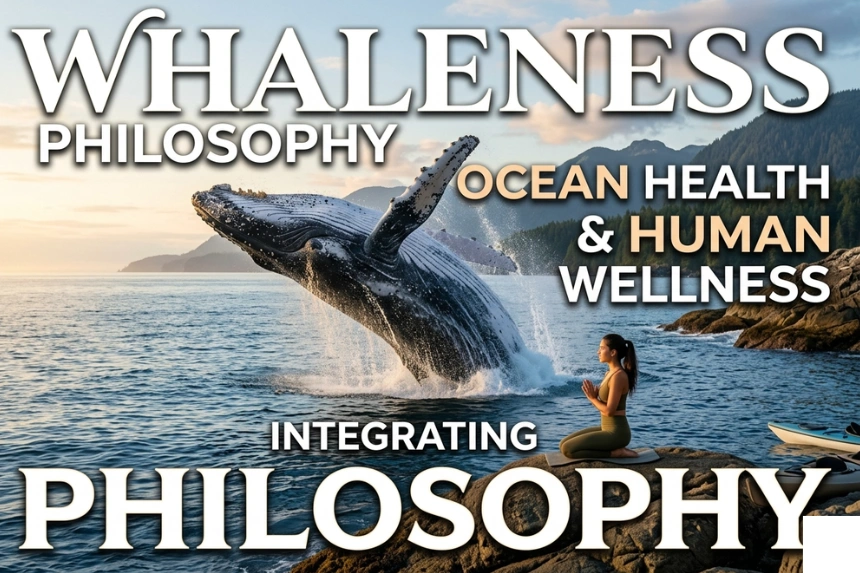
A holistic wellbeing philosophy rooted in the ocean’s greatest giants
Whaleness is a holistic wellbeing philosophy inspired by whales and their vital role in ocean and planetary health. It connects human wellness with environmental balance, emphasizing deep rest, community, purpose, and regenerative living as keys to true wellbeing for both people and the planet.
What Is Whaleness?
Whaleness is a growing holistic wellbeing movement and philosophy. It is defined as “the wellbeing created by whales, for the planet and the people.” In simple terms, it looks at whales, how they live, what they do for the ocean, and how their existence shapes life on Earth- and asks a powerful question: What can we learn from them about living well?
Whaleness sits at the crossroads of ocean health, human wellbeing, environmental balance, and conscious living. It draws from marine biology, ecology, mindfulness, and sustainability to offer a new lens through which professionals and changemakers can understand health, not just for themselves, but for the planet.
Why Whales? The Connection Between Ocean Health and Human Health
At first, it might seem strange to connect whales to human wellbeing. But the link is real, and it runs deep.
Whales are what scientists call keystone species. This means their presence, or absence, has a massive ripple effect on the entire ocean ecosystem. When whales thrive, the ocean thrives. And when the ocean thrives, so do we.
Whales feed in the deep ocean and come to the surface to breathe. When they do, they release nutrient-rich waste near the top of the water. This feeds phytoplankton, the tiny ocean plants that produce more than half of the world’s oxygen. More phytoplankton means more oxygen. More oxygen means healthier air for all life on Earth.
Whales also help regulate carbon in the atmosphere. When a whale dies, its body sinks to the ocean floor, carrying with it decades’ worth of stored carbon. This natural process, sometimes called the “whale pump,” plays a real role in slowing climate change.
This is the core idea behind whaleness. It reminds us that our wellbeing is not separate from nature’s wellbeing. They are one and the same.
The Pillars of Whaleness
The whaleness philosophy is built on several key ideas, each inspired by the way whales exist in the world.
1. Deep Rest and Inner Stillness
Whales sleep differently from most animals. They rest in a state called unihemispheric slow-wave sleep, where one half of the brain rests while the other stays alert. They float quietly near the surface, calm, still, and present.
This teaches us the value of genuine rest. Not just sleep, but real stillness. In a world that rewards constant productivity, whaleness encourages people to embrace deep rest as a pillar of wellbeing, not a weakness.
2. Community and Communication
Whales are highly social beings. Humpback whales sing complex songs that travel thousands of miles underwater. Sperm whales live in tight family groups and communicate with clicking sounds called codas, and researchers have discovered that different whale groups have their own “dialects.”
This reflects a truth about human wellbeing too: we are wired for connection. Whaleness honors the role of community, meaningful communication, and shared experience in maintaining mental and emotional health.
3. Long-Distance Migration and Purpose
Many whale species travel thousands of miles every year. They move between feeding grounds and breeding grounds with remarkable consistency. They don’t wander aimlessly, they move with direction and purpose.
For humans, this mirrors the importance of having a sense of direction in life. Whaleness encourages people to find their own “migration path”, a life lived with intention, moving toward what matters most.
4. Environmental Stewardship
Whales don’t just exist in their environment, they actively improve it. They feed it, enrich it, and restore it. This is the most radical idea in whaleness: that true wellbeing is regenerative, not extractive.
Professionals and organizations aligned with whaleness ask: Are we leaving the world better than we found it? This goes beyond recycling or carbon offsets, it’s a full shift in mindset toward restoration and contribution.
Whaleness and Professional Wellbeing
For professionals and leaders, whaleness offers a meaningful framework that goes beyond typical wellness programs. It challenges the way we think about performance, health, and impact.
Here’s what applying whaleness looks like in a professional context:
Sustainable productivity over burnout culture. Just as whales move in rhythm with the ocean’s natural patterns, whaleness calls on professionals to work in sync with their natural energy cycles, building in rest, recovery, and reflection.
Systems thinking. Whales understand, at a biological level, that they are part of a larger system. Whaleness encourages professionals to zoom out and ask how their work affects the broader ecosystem: their teams, communities, and the environment.
Depth over noise. Whale song is not loud for the sake of being loud. It carries meaning across vast distances. Whaleness pushes leaders and communicators to prioritize depth, clarity, and authenticity in how they show up and speak.
Why Whaleness Matters Right Now
We are living in a time of rising burnout, growing disconnection from nature, and increasing awareness about the climate crisis. These are not separate problems, they are deeply linked.
Whaleness arrives as a philosophy that holds all of these together. It says: you cannot truly be well if the planet is unwell. And the planet cannot heal if the people living on it are burned out, disconnected, and running on empty.
Related concepts like blue mind (the calming effect of water on the human brain), biophilia (humans’ innate need to connect with nature), ocean therapy, and ecological wellbeing are all in conversation with whaleness. Together, they are building a growing movement that recognizes the ocean, and its greatest guardians, as teachers of how to live well.
Small Ways to Practice Whaleness
You don’t have to be a marine biologist to embrace whaleness. Here are some grounded, practical ways to bring this philosophy into your life:
Spend time near water. Research consistently shows that being near the ocean, rivers, or lakes reduces stress and boosts mood.
Practice deep, slow breathing. Whales are conscious breathers, every breath is intentional. Try breathing exercises that slow you down and bring you back to the present.
Protect ocean health. Reduce single-use plastics, support marine conservation organizations, and stay informed about ocean policy.
Rest without guilt. Schedule real downtime, not scrolling, not planning, just being.
Reconnect with community. Reach out. Share. Listen deeply. Build the kind of bonds that whales model through their lifelong social ties.
Final Thoughts
Whaleness is more than a wellness trend. It is a philosophy that calls us back to something essential: the understanding that we are part of a living world, and that our wellbeing is inseparable from the wellbeing of that world.
Whales have roamed the oceans for millions of years. They breathe air like we do. They sing, grieve, rest, and care for one another. And quietly, powerfully, they keep the planet alive.
When we protect whales, we protect ourselves. When we learn from them, we grow wiser. And when we build a life guided by the values they embody, depth, rest, community, purpose, and restoration, we move closer to what it truly means to be well.