
Introduction
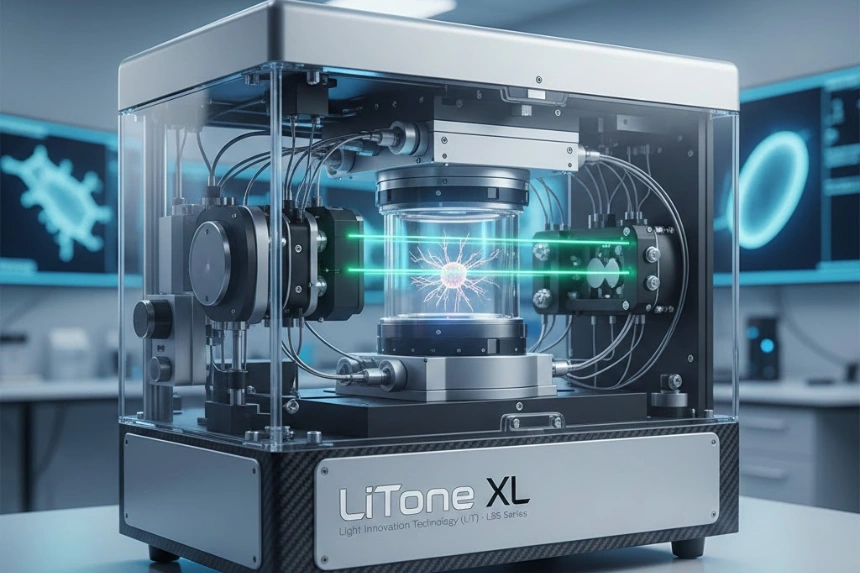
In the world of biological imaging, high-quality microscopes are crucial for understanding the intricacies of life at the cellular level. LiTone, a leading brand by Light Innovation Technology (LiT), has revolutionized this field with its Line Bessel Sheet (LBS) light-sheet microscopy solutions. Designed for high-resolution, fast, and low-phototoxicity imaging, LiTone microscopes provide researchers with powerful tools to explore life in three dimensions.
What is LiTone?
LiTone is a line of advanced light-sheet microscopes developed by Light Innovation Technology (LiT). These microscopes are built to address the limitations of traditional imaging methods, particularly when working with delicate biological samples. Using Line Bessel Sheet (LBS) technology, LiTone microscopes can capture precise 3D images with minimal damage to living cells, making them ideal for long-term imaging studies.
Key Features of LiTone Microscopes
LiTone microscopes are packed with innovative features that make them stand out in the field of light-sheet microscopy:
1. High-Speed Imaging
With LBS technology, LiTone microscopes can capture multiple planes in rapid succession. This is essential for studying fast biological events, such as neural activity or cell division, without missing critical moments.
2. Minimal Photodamage
Phototoxicity is a common issue in live-cell imaging. LiTone’s LBS illumination uses less light energy per plane, protecting sensitive cells during long-term studies.
3. Large Field of View
The unique properties of the Bessel beam allow imaging across wider areas without compromising resolution, making it easier to capture large samples or entire tissues.
4. User-Friendly Software
LiTone microscopes come with intuitive software that simplifies image acquisition, processing, and analysis. Researchers can focus on experiments instead of complex setups.
5. Versatility
LiTone supports various sample types, from single cells to entire organoids or small organisms, offering flexibility for different research applications.
How LiTone Works
LiTone microscopes use Line Bessel Sheet (LBS) light-sheet technology to look at biological samples. Unlike regular light-sheet microscopes that use a thin Gaussian light sheet, LBS creates a Bessel-shaped light beam. This helps provide clearer and more detailed images.
Key steps in its working:
Illumination: The Bessel beam scans a single plane of the sample with minimal light exposure, reducing photodamage.
Detection: A perpendicular objective collects the emitted fluorescence from the illuminated plane.
3D Imaging: By moving the sample or the light sheet, LiTone captures multiple planes, which are then combined to produce high-resolution 3D images.
Processing: Advanced software reconstructs and analyzes the images quickly, providing clear visualization of dynamic biological processes.
This method allows fast, high-resolution imaging of living cells and tissues while preserving their natural state, making LiTone ideal for long-term studies.
Applications of LiTone in Biological Research
LiTone microscopes have a wide range of applications, particularly in the life sciences:
1. Developmental Biology
Researchers can observe embryos or developing tissues in real-time, capturing detailed 3D structures and developmental processes.
2. Neuroscience
LiTone’s fast, high-resolution imaging allows scientists to track neural networks and brain activity with minimal disruption to live tissue.
3. Cellular Dynamics
From monitoring cell division to intracellular transport, LiTone provides the tools to study cells in their natural, living state.
4. Drug Discovery
Pharmaceutical researchers can use LiTone to test drug effects on live cells and tissues, observing cellular responses in 3D without causing damage.
5. Tissue Engineering
For regenerative medicine and tissue research, LiTone enables detailed imaging of complex 3D constructs, helping scientists assess structure and functionality.
Advantages Over Traditional Microscopy
While confocal and wide-field microscopes have been widely used in research, LiTone LBS microscopy offers several advantages:
| Feature | Traditional Microscopy | LiTone LBS Microscopy |
|---|---|---|
| 3D Imaging | Limited | High-resolution, full 3D |
| Imaging Speed | Moderate to slow | Fast, real-time imaging |
| Phototoxicity | High in live cells | Minimal, suitable for long-term studies |
| Field of View | Narrow | Large, uniform illumination |
| Sample Types | Limited | Flexible for cells, tissues, organoids |
This combination of speed, resolution, and low phototoxicity makes LiTone an ideal choice for modern biological research.
Tips for Using LiTone Microscopes
1. Optimize Sample Preparation: Use clean, well-mounted samples to reduce background noise and improve image clarity.
2. Adjust Light Intensity: Use the lowest effective illumination to minimize phototoxicity for live-cell imaging.
3. Calibrate Regularly: Periodically check alignment and focus to maintain consistent high-resolution imaging.
4. Use Software Tools: Take advantage of LiTone’s built-in software for real-time image reconstruction and analysis.
5. Plan 3D Imaging: Strategically set Z-step sizes to balance image resolution with acquisition speed.
6. Maintain Clean Optics: Regularly clean objectives and light paths to prevent artifacts in images.
7. Document Settings: Record imaging parameters for reproducibility in long-term or comparative experiments.
Why Researchers Choose LiTone
Researchers choose LiTone microscopes because they address the common challenges of live-cell imaging while enabling new discoveries. By reducing photodamage, increasing imaging speed, and maintaining high resolution, LiTone makes it easier to capture the dynamic processes that define life at the microscopic scale.
Additionally, LiTone’s user-friendly design and software reduce the learning curve, making advanced microscopy accessible to more scientists and research teams.
Future of Light-Sheet Microscopy with LiTone
As biological research pushes the boundaries of what we can see and understand, the demand for imaging tools that are precise, fast, and gentle on living samples is greater than ever. LiTone rises to this challenge with its Line Bessel Sheet technology, offering a cutting-edge solution for modern microscopy.
With LiTone, researchers can look forward to clearer and more detailed live-cell imaging, even in complex tissues, without compromising cell health. Its advanced system also supports multi-color imaging, allowing scientists to observe multiple structures or processes simultaneously.
Conclusion
LiTone by Light Innovation Technology represents a significant leap forward in light-sheet microscopy. Its Line Bessel Sheet technology enables high-resolution, fast, and low-phototoxicity imaging, empowering researchers to explore cellular and tissue dynamics like never before. From developmental biology to drug discovery, LiTone microscopes offer the precision and reliability needed for cutting-edge research.