
Introduction
The CSCS mock test for operatives is one of the most practical steps any construction worker can take before sitting the official CITB Health, Safety and Environment (HS&E) test. Whether you are entering the industry for the first time, renewing an existing card, or switching to a site-based role, understanding how the operatives test works, and how to prepare for it effectively, can be the difference between passing first time and having to rebook.
This guide covers everything you need to know about the CSCS operatives test, what a mock test involves, how the exam is structured, and how to approach your revision to maximise your chances of success.
What Is the CSCS Operative Test and Who Needs It
The CSCS card is the industry-standard proof that a worker has the required health, safety, and environmental knowledge to operate safely on a UK construction site. While holding a CSCS card is not a statutory legal requirement, virtually every major principal contractor and housebuilder in the UK requires workers to carry a valid card before they are permitted on site. Failing to hold the correct card can result in being refused site access entirely.
The CITB Health, Safety and Environment test, commonly referred to as the CSCS test, comes in three versions: the Operatives test, the Specialists test, and the Managers and Professionals (MAP) test. The Operatives test is the entry-level assessment and is the one most construction workers will sit.
It is the required test for anyone applying for a Green CSCS Labourer card, a Blue Skilled Worker card (in most trades), or one of the red temporary training cards. If you are a labourer, groundworker, bricklayer, carpenter, painter, plasterer, or general site operative, the Operatives test is the assessment you need to pass. Cards are valid for five years, and each time you apply or renew you must have passed the relevant HS&E test within the previous two years, meaning most workers return to this test on a regular basis throughout their career.
Structure and Format of the CSCS Operatives Test
Understanding the format of the test before you sit removes a significant layer of uncertainty on the day. The Operatives test consists of 50 multiple-choice questions, which must be completed within 45 minutes. The pass mark is 45 out of 50, equivalent to 90%, which means you can afford a maximum of five incorrect answers.
Questions are delivered on screen at a Pearson VUE test centre and are drawn randomly from a large bank of questions organised across four core sections. Some questions require a single correct answer; others require you to identify multiple correct answers from a list. Selecting all correct options is necessary to score the point on multi-answer questions, so reading each question carefully before responding is important.
The CITB test can be taken with a voice-over in English or Welsh, and voice-over support is available in a range of European languages, making the assessment accessible to workers who prefer to take it in their first language.
The Four Core Test Sections
The 50 questions span four main topic areas, each covering a distinct aspect of health and safety on construction sites.
Section A – Working Environment covers accident reporting and recording, first aid and emergency procedures, general responsibilities, environmental awareness and waste control, and the correct use of personal protective equipment (PPE). Questions in this section test your understanding of why procedures matter, not just what they involve.
Section B – Occupational Health addresses health and welfare on site, the risks posed by dust and fumes, noise and vibration exposure, and safe manual handling techniques. This section recognises that construction work carries long-term health risks beyond immediate physical injury, and candidates are expected to understand how to mitigate them.
Section C – Safety covers electrical safety, the correct use of tools and equipment, fire prevention and control, and the interpretation of safety signs. Recognising mandatory, prohibition, and warning signs is a topic that appears consistently across practice materials and is worth reviewing carefully.
Section D – High Risk Activities examines working at height, safe working in excavations and confined spaces, hazardous substances (including COSHH awareness and asbestos), and site transport safety and lifting operations. This section carries particular weight because the activities it covers are responsible for a disproportionately high share of serious construction site injuries.
The Role of CSCS Mock Tests in Operative Preparation
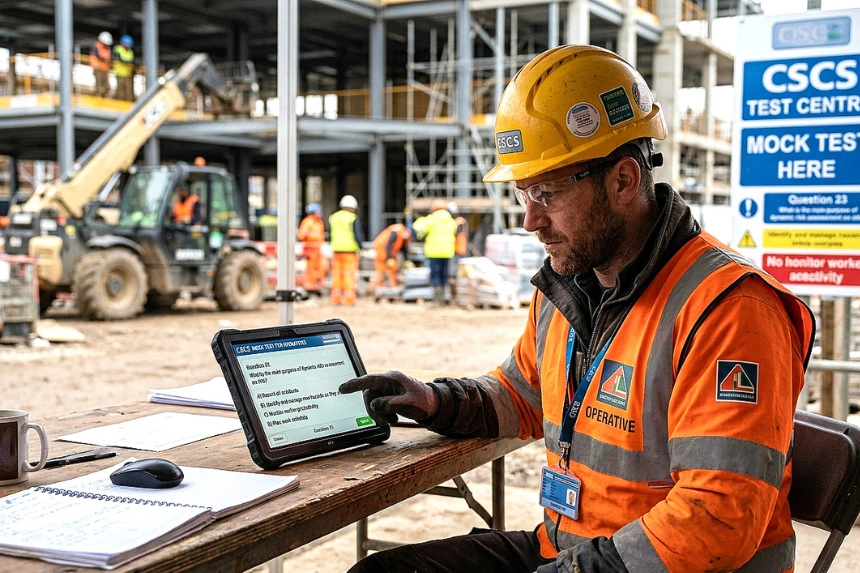
A CSCS mock test for operatives is a practice exam that replicates the format, question style, and time constraints of the real CITB assessment. Free mock tests are widely available online and are structured to mirror the official exam as closely as possible 50 questions, 45-minute timer, mix of single and multiple correct answer formats, and topics drawn from across the four core sections.
Mock tests serve several distinct purposes in the preparation process. They familiarise you with question phrasing, which in the real exam is precise and sometimes deliberately nuanced. Candidates who have only read revision notes can be caught off guard by the way questions are worded, even when they know the underlying material. Regular practice under timed conditions resolves this quickly.
They also identify weak areas. Completing multiple mock tests and reviewing incorrect answers systematically reveals which topics require more focused revision. A candidate who consistently drops marks on noise and vibration or working at height questions knows exactly where to direct additional study time. Without mock test feedback, this kind of targeted revision is much harder to achieve.
Finally, mock tests build the kind of confidence and familiarity with the exam experience that makes a meaningful difference to performance on the day. The 45-minute time limit is generous for most candidates, but knowing that you can complete 50 questions comfortably within the window reduces the risk of rushed or careless answers in the final minutes.
Tips to Pass the CSCS Mock Test for Operatives
Treat every mock test like the real exam: Sit it in one go, use a 45-minute timer, and avoid distractions. This builds real exam confidence.
Don’t guess multi-answer questions: If a question needs 2 or 3 answers, guessing one correctly still scores zero. Be sure before selecting.
Review every wrong answer immediately: The real learning happens after the test. Understand why you got it wrong, not just the correct option.
Focus on weak sections first: If you keep failing questions on working at height or PPE, revise that topic before doing another mock.
Learn safety signs visually: Many questions are image-based. Repeatedly practice sign recognition until it becomes instant.
Flag and return strategy: In mocks, practice skipping hard questions and coming back later. It prevents rushing at the end.
Aim for 48+ in practice tests: Don’t just aim to pass (45). Target higher scores to build a safety margin for the real exam.
Study little and often: 30-40 minutes daily with mock tests + revision works better than last-day cramming.
Simulate pressure before test day: Do at least 2–3 full mock tests under strict conditions before booking the real exams.
Booking the Official CITB Test and Applying for Your CSCS Card
The CITB HS&E test is booked directly through the CITB website and delivered at Pearson VUE test centres across the UK. The test costs £22.50, and centres are available in most towns and cities, with next-day and ASAP appointments often accessible depending on location. Voice-over options can be selected at the time of booking.
Once you have passed the test, you can apply for your CSCS card through the official CSCS website or via the My CSCS app, which uses an AI-driven process to recommend the correct card type based on your qualifications. For a Green Labourer card, you will also need to provide evidence of completing the Level 1 Award in Health and Safety in a Construction Environment, or an approved equivalent qualification. The CSCS card itself costs £36 and is valid for five years from the date of issue.
If you fail the Operatives test, you are able to rebook and resit. There is no mandatory waiting period between attempts for the Operatives test, though it is worth taking time to review the areas where you dropped marks before resitting rather than booking immediately.
Common Reasons Candidates Fail the Operatives Test
Understanding why candidates fail helps you avoid the same pitfalls. The most common cause is underestimating the precision the test demands. This is not an assessment that rewards vague familiarity, the 90% pass mark means that thorough preparation across all four sections is necessary, with no single topic being treated as optional.
The Challenge of Multi-Answer Questions
Multi-answer questions are a frequent source of dropped marks. Selecting one correct answer from a list of two is an incomplete response and scores no points. Reading the question instructions carefully, whether it says “give ONE answer” or “give all that apply”, is essential throughout the exam.
Time Management Mistakes During the Test
Time management is rarely the issue for most candidates, but a small number of test-takers spend too long on difficult questions and then rush through the remainder. The better approach is to mark uncertain questions for review, proceed through the full test, and return to those questions using remaining time at the end.
Conclusion
The CSCS mock test for operatives is an indispensable part of preparing for the CITB Health, Safety and Environment assessment. Used alongside structured topic revision and official CITB materials, it builds the familiarity, confidence, and knowledge depth needed to pass at the 90% threshold the test requires.
For anyone entering the UK construction industry or renewing an existing card, investing time in thorough preparation is the most reliable route to first-time success, and to the site access that a valid CSCS card provides.