
Introduction
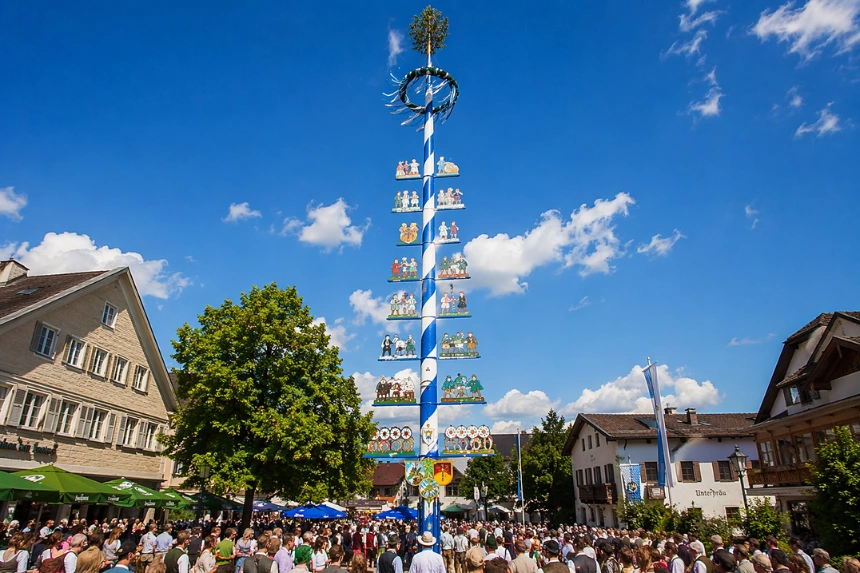
Every year, as winter gives way to spring, town squares across Germany, Austria, and neighbouring regions undergo a striking transformation. A towering, decorated pole, often stretching 18 to 30 metres into the sky, rises above the community, adorned with ribbons, wreaths, carved guild signs, and the vivid blue-and-white colours of Bavaria. This is the Mainbaum, and for the communities that erect it, the occasion is far more than a seasonal spectacle.
The Mainbaum (also widely spelled Maibaum) represents one of Europe’s most enduring folk traditions, one rooted in ancient beliefs about nature, fertility, and collective identity. Yet for many outside the German-speaking world, the tradition remains unfamiliar. What exactly is a Mainbaum? Where does it come from? And why do communities continue to invest considerable effort in raising one each spring?
What Is the Mainbaum?
The word Mainbaum translates directly from German as “May tree,” and the name captures its essence: a tall tree trunk, stripped of its branches, erected as a centrepiece of spring celebrations on or around 1 May each year.
The Meaning Behind the Decorated Pole
At its core, the Mainbaum is a symbol of renewal, fertility, and community unity. The pole itself typically retains its evergreen crown, a deliberate preservation that signals rebirth and the continuity of life after winter. In many communities, the trunk is painted in a spiralling pattern of blue and white, the regional colours of Bavaria, and decorated with colourful wooden signs depicting the local trades, guilds, and civic organisations. A decorative wreath is often suspended from the upper section of the pole, completing its festive appearance.
Beyond its visual identity, the Mainbaum functions as a marker of communal pride. Its presence in the village square signals that a community is active, cohesive, and connected to its cultural heritage. In some regions, the pole is also referred to as the Marienbaum, reflecting its absorption into local Christian customs over the centuries. Each village’s Mainbaum is, in this sense, unique, a physical expression of local identity rather than a standardised artefact.
The Historical Origins of the Mainbaum
The origins of the Mainbaum are a subject of considerable historical debate, but most scholars trace its roots to pre-Christian Germanic traditions. Early Germanic tribes are understood to have venerated sacred trees as embodiments of forest deities, associating certain species — particularly oaks, with divine power and the forces of nature. The worship of these trees formed part of broader spring rituals intended to encourage fertility, protect the community, and honour the return of warmth and growth after winter.
As Christianity spread through the Germanic regions, these pagan customs did not disappear — they evolved. Documented references to Pentecost trees in parts of the Eifel region date the practice to at least the 13th century, and by the 16th century the tradition had taken on much of the shape recognised today: a tall trunk erected in a prominent communal space, adorned with decorations, and celebrated with music and dancing. From the 19th century onwards, the Mainbaum became increasingly associated with local civic identity, with independent communities using it as a symbol of their autonomy and collective spirit.
The tradition’s connection to Walpurgisnacht, the night of 30 April, which in Germanic folklore was believed to be a time when witches and evil spirits gathered, also shaped its cultural context. Communities would light bonfires and gather in celebration partly as a means of warding off these forces, and the raising of the Mainbaum became intertwined with this protective, communal impulse. Over time, these superstitious elements faded, but the spirit of collective gathering they inspired remained central to the tradition.
How Mainbaum Celebrations Work
The Mainbaum is not simply erected and left to stand. Its raising is a full community event, accompanied by a range of customs and activities that vary from region to region but share a common emphasis on participation, music, and shared festivity.
The Raising of the Mainbaum
The physical act of raising the Mainbaum, known in German as Maibaum Aufstellen, is itself a significant community undertaking. In many villages, the pole is hoisted entirely by hand using a system of long supporting poles called Scherenstangen, with teams of volunteers working in coordination under the guidance of experienced community members. The process can take several hours and draws crowds of onlookers who gather to watch, cheer, and participate in the celebrations that follow. In larger towns and cities, cranes are sometimes used, though the hand-raising method remains a point of pride in communities where it is still practised.
Before the raising takes place, the pole must be sourced, typically a tall, straight tree felled from a local forest, and prepared. Local organisations, often youth groups, fire brigades, or civic associations, take responsibility for felling, transporting, decorating, and ultimately erecting the Mainbaum. The decorations are applied with care, with each guild sign or carved figure reflecting something specific to the community’s history or trades.
Tanz in den Mai: Dance, Music, and Festivities
Once the Mainbaum is in place, the celebrations begin in earnest. The central event of the spring festival is Tanz in den Mai — literally “Dance into May” — a night of communal dancing and revelry held on the evening of 30 April, leading into May Day itself. Brass bands, accordion players, and folk musicians provide the soundtrack, while traditional dances are performed by costumed groups in the area surrounding the pole.
Beer gardens play a central role in the festivities, with seasonal brews, particularly Maibock and Starkbier — served alongside traditional Bavarian food. In some regions, a May Queen (Maikönigin) is elected to lead the celebrations, wearing a floral crown and presiding over ceremonial events. The atmosphere is distinctly communal: families, young people, and older residents participate together, making Tanz in den Mai one of the most intergenerational celebrations in the German cultural calendar.
In addition to dancing, Maibaum Kraxeln, maypole climbing competitions, are held in many communities, where participants attempt to scale the pole to reach prizes fixed at the top. These events are accompanied by considerable community spirit and good-natured competition.
Maibaumklau – the Playful Tradition of Maypole Theft
One of the most distinctive and entertaining aspects of the Mainbaum tradition is Maibaumklau, the theft of the Maypole. In the days leading up to May Day, rival villages may attempt to steal a neighbouring community’s Mainbaum, typically under cover of darkness. If the theft is successful, the thieves are entitled to demand a ransom, traditionally paid in barrels of beer and food, before returning the pole.
The custom operates according to a strict informal code: the pole must not be damaged, no force may be used, and the thieves must remain undetected until the Mainbaum has been successfully removed. If the guarding community, typically composed of younger members of local clubs and fire brigades who spend the night watching over the pole, detects the theft attempt before it is complete, the thieves must retreat empty-handed. The whole tradition functions as a form of structured, playful inter-community rivalry that reinforces social bonds rather than creating genuine conflict. It is the kind of folkloric storytelling made physical, the sort of cultural dynamic explored in narratives like the fairy tale about 3 princes, where community roles, rules, and rivalries are enacted through ritual rather than resolved through force.
Where Can You Experience a Mainbaum Celebration?
The Mainbaum tradition is most deeply embedded in Bavaria and Baden-Württemberg in southern Germany, as well as in Austria and parts of Switzerland and Liechtenstein. Within Bavaria, the celebrations are particularly prominent in smaller towns and villages, where the Mainbaum serves as a focal point of the local community rather than a tourist attraction.
Towns such as Garmisch-Partenkirchen, Aying (a village south of Munich), and Bad Wörishofen host well-regarded Mainbaum celebrations, each with its own local character. Munich’s Viktualienmarkt, the city’s famous open-air market, also erects a Mainbaum each year, making it accessible to visitors in the city centre. Not all communities raise a new Mainbaum annually; some replace theirs every two to five years, with safety regulations typically requiring replacement after five years at most.
For those planning to attend, the official Bavarian tourism authority maintains listings of upcoming Maibaum Aufstellen events, making it possible to identify which communities will be celebrating in a given year. Early May is the primary window, with many events concentrated around 30 April and 1 May.
Why the Mainbaum Still Matters Today
In an world of rapid digital transformation and shifting cultural landscapes, the persistence of the Mainbaum tradition is notable. Communities continue to invest significant time, effort, and resources into sourcing, preparing, decorating, and raising a pole, not because they are required to, but because the act of doing so reinforces something that many modern communities find difficult to cultivate: a shared sense of place and collective identity.
The Mainbaum functions as a visible commitment by a community to its own continuity. The young people who guard it through the night, the craftspeople who carve its guild signs, the musicians who play at its raising, all are participating in a living cultural ecosystem that connects them to generations past. Research into spring festival traditions across Europe consistently highlights the social cohesion function of rituals of this kind, noting that communities which maintain shared ceremonies tend to demonstrate stronger inter-generational bonds and higher levels of civic participation.
Conclusion
The Mainbaum is one of Europe’s most distinctive and enduring folk traditions, a decorated pole that carries within it centuries of cultural memory, community identity, and seasonal symbolism. From its roots in pre-Christian Germanic tree worship to its present-day role as a focal point of spring celebrations across Bavaria, Austria, and beyond, the Mainbaum has demonstrated a remarkable capacity to remain relevant across radically different historical contexts.
For those with an interest in European cultural heritage, attending a Mainbaum celebration offers a rare opportunity to witness a living tradition, one that is neither preserved in a museum nor performed for tourists, but enacted each year by communities for their own benefit. Plan a visit to southern Germany or Austria in late April or early May, and experience firsthand how a centuries-old custom continues to bring people together around a single, towering symbol of renewal.