
Introduction
In the production of expanded polystyrene, one of the most widely used materials in construction, packaging, and manufacturing, the EPS silo plays a foundational role that is often underestimated. Before a single block of insulation foam or protective packaging tray reaches its final form, the raw EPS beads must pass through a critical preparation stage. That stage happens inside the EPS silo.
Whether you are setting up a new EPS production line, evaluating storage solutions for an existing facility, or simply trying to understand the full manufacturing workflow, this guide covers what an EPS silo is, how it functions, what variants exist, and why selecting the right system can directly influence your production quality and operational efficiency.
What Is an EPS Silo?
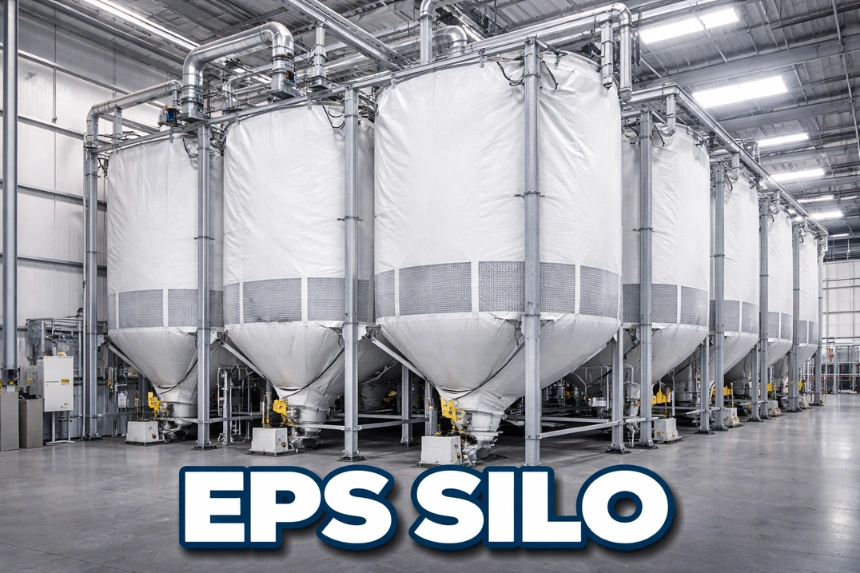
An EPS silo, also referred to as an EPS aging silo, EPS bead storage silo, or ripening silo, is a large container or tank used to store and prepare EPS beads between the pre-expansion stage and the moulding stage of production. It is a standard component of any EPS manufacturing facility, and its role goes well beyond passive storage.
When EPS beads exit the pre-expander, they are warm, damp, and internally unstable. The blowing agent (typically pentane) that drove the expansion has created a pressure differential between the inside and outside of each bead cell. If the beads were fed directly into a mould at this point, the resulting product would be structurally compromised, inconsistent in density, prone to collapse, and poor in surface quality.
The EPS silo addresses this by providing a controlled environment where the beads can stabilise. Over a period of several hours, typically between 6 and 72 hours depending on bead density, ambient conditions, and raw material grade, the internal pressure equalises, surface moisture evaporates, and the beads recover their elasticity. This process is known as maturation or aging, which is why the EPS silo is commonly called an aging silo
How Does an EPS Silo Work?
What Happens During the Maturation Process?
Once pre-expanded beads are transferred into the silo via pneumatic conveying systems, three key processes occur simultaneously:
Pressure equalisation: The foaming agent inside the bead cells condenses after pre-expansion, creating negative pressure within each pore. Air gradually diffuses through the bead walls, restoring equilibrium between internal and external pressure. This prevents the beads from collapsing and restores their structural resilience.
Moisture evaporation: Freshly expanded beads carry surface moisture from the steam process. The silo’s breathable fabric walls allow moisture-laden air to escape passively, drying the beads without the need for active heating. Dry beads have a faster gas permeation rate, which accelerates the maturation timeline.
Elasticity recovery: As pressure and moisture stabilise, the beads regain the flexibility and expandability needed for the moulding stage. Properly matured beads fuse together more effectively under steam, produce a more uniform cell structure, and yield a final product with consistent mechanical properties.
How Is Bead Flow Managed?
Most modern EPS silos are integrated into automated or semi-automated plant systems. Beads are loaded through inlet pipes typically 150–250mm in diameter, and level control sensors monitor minimum and maximum fill thresholds in real time. When production demand signals that bead stock is needed, discharge units release material through outlet pipes directly to the block moulding or shape moulding stations.
In fully automated configurations, PLC-controlled systems manage loading, discharging, and inventory tracking without manual intervention, reducing human error, minimising contamination risk, and maintaining a consistent material flow that prevents production downtime.
Types of EPS Silo
EPS silos are available in several configurations, each suited to different facility layouts, production volumes, and operational requirements.
1. Fabric Bag Silos
The most common type found in EPS facilities worldwide. The silo bag is sewn from antistatic synthetic polyester fabric, which serves two critical functions: it allows the beads to breathe (enabling moisture and gas exchange during maturation) while preventing static charge build-up that could ignite pentane vapour. Fabric bag silos are mounted on galvanised steel pipe frames, which can be assembled and disassembled without specialist tools — making them suitable for both indoor and outdoor installation. Sizes typically range from 1.5 m³ to 150 m³, with custom configurations available.
2. Steel Silo Systems
More common in large-scale or heavily automated facilities, steel silos offer greater structural rigidity and can be designed to meet ATEX (explosive atmosphere) directives — an important consideration given that pentane, the blowing agent used in EPS production, is flammable. Steel systems often incorporate automatic pentane gas level monitoring and filtered air outlets to manage safety at scale.
3. Automated Silo Plants
Fully integrated silo plants combine multiple storage units with centralised control systems, pneumatic conveying networks, diverters, and shutters managed through a touchscreen interface. These systems enable manufacturers to manage multiple bead grades simultaneously, optimise aging time per batch, and integrate directly with Industry 4.0 monitoring platforms. Aging time control with automated notifications ensures that no batch is fed to production before it has fully matured.
Key Features to Evaluate in an EPS Silo
Why Is Antistatic Design Non-Negotiable?
EPS beads are light, highly mobile, and prone to generating static electricity during pneumatic transfer. Pentane vapour, which remains present in and around pre-expanded beads during the maturation period, is highly flammable. An EPS silo without adequate antistatic protection presents a genuine safety risk in any production environment.
Quality EPS silo fabrics use woven antistatic threads (carbon-based, not steel, to avoid puncture risk) distributed throughout the weave, meeting EN 1149-1-3-5 standards for electrostatic discharge. When evaluating a silo, confirmation of antistatic compliance is not optional — it is a baseline safety requirement.
What Role Does Breathability Play in Bead Quality?
The silo fabric must be permeable to gas and moisture but impermeable to fine EPS particles (dust). High-quality silo bag materials offer air permeability levels of up to 400 litres per square decimetre per minute at 200 Pascal, enabling efficient passive ventilation while maintaining a clean production environment. Inadequate breathability slows maturation and can lead to underprepared beads entering the moulding stage, resulting in product defects, wasted material, and increased reject rates.
How Are Silos Sized for Production Capacity?
Silo capacity should be matched to daily production volume and maturation cycle duration. A facility producing high-density beads (above 35 kg/m³) may require only 4-8 hours of maturation time, allowing faster silo turnover and smaller total capacity. Lower-density beads and those produced in humid or cool conditions require longer hold times and proportionally larger storage capacity. Leading manufacturers offer custom sizing and plant layout optimisation as part of the specification process.
Why EPS Silos Are Critical to Production Quality
How Does Silo Performance Affect Final Product Quality?
The maturation process directly determines the quality of everything downstream in an EPS production line. Beads that enter the mould without adequate aging produce blocks with poor sinterability, meaning individual beads fail to fuse properly, leading to weak structural integrity, inconsistent density, and rough surface finish. In packaging applications, this translates to inadequate impact protection. In construction insulation, it compromises thermal performance and compressive strength.
Conversely, a well-designed EPS silo that maintains consistent breathability, stable temperature conditions, and precise inventory management enables repeatable, high-quality output. The silo is not the most visible component on a production floor, but it is one of the most influential.
What Is the Market Context for EPS Production Equipment?
The global expanded polystyrene market was valued at approximately USD 17.98 billion in 2025 and is projected to expand at a compound annual growth rate of around 5.7%, potentially surpassing USD 31 billion by 2035. Construction accounts for the largest application segment, with packaging and automotive uses driving additional demand. Asia-Pacific currently holds the dominant regional share, underpinned by rapid urbanisation and infrastructure investment across China, India, and Southeast Asia.
As production volumes scale across these markets, the pressure on facility operators to maintain output quality, minimise downtime, and meet increasingly stringent environmental standards is intensifying. EPS silo systems, particularly those compatible with Industry 4.0 integration and designed with sustainability considerations in mind, are becoming a more strategically important investment for manufacturers looking to streamline operations and remain competitive.
Considerations When Specifying an EPS Silo
Installing or upgrading an EPS silo system requires attention to several operational variables beyond raw capacity. The layout of the production facility determines whether indoor or outdoor installation is viable, and whether modular frame designs or fixed steel structures better suit the available footprint. Pentane management, including monitoring, filtration, and ATEX compliance, must be addressed from the outset, particularly for larger automated plants.
Maintenance access is another key factor. Silo bags with zipper closures at the cone base allow for complete cleanout without dismantling the structure, which streamlines changeovers between bead grades and reduces contamination risk. Level control sensors should be integrated from installation to enable real-time inventory data, which supports both production scheduling and quality control.
Conclusion
The EPS silo is a deceptively simple piece of equipment that carries significant weight in the quality and efficiency of any EPS production operation. By providing the controlled environment that pre-expanded beads need to mature, dry, and stabilise before moulding, the silo directly influences everything from cell structure uniformity to final product strength. As the global EPS industry continues to expand, investing in well-specified, safety-compliant, and appropriately sized silo infrastructure is a practical step toward sustainable, high-quality production.