
Introduction
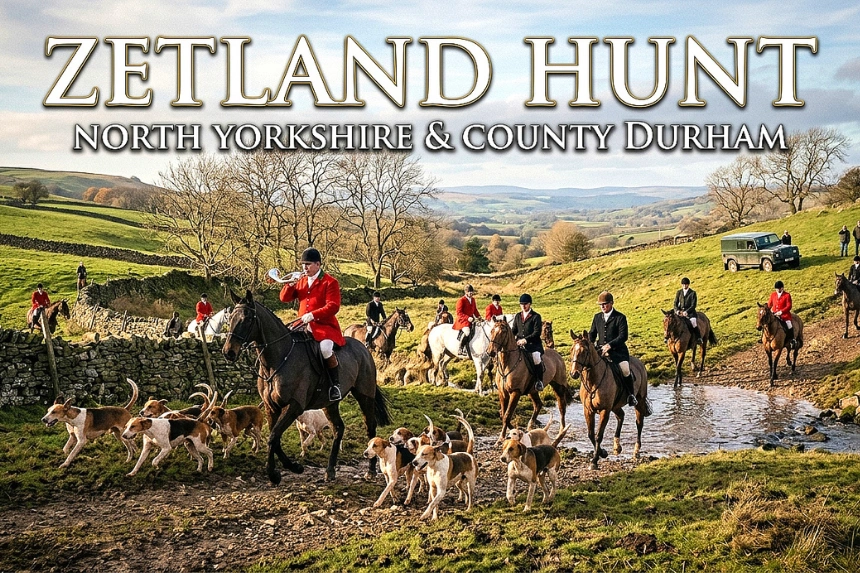
The Zetland Hunt stands as one of England’s oldest and most enduring rural institutions, a traditional foxhound pack with roots stretching back to 1787. Straddling the border of County Durham and North Yorkshire, this hunt has navigated centuries of social and legislative change while continuing to serve as a cornerstone of its local countryside community.
Whether you’re a countryside enthusiast, a heritage researcher, or simply curious about how rural British traditions have adapted to the modern era, understanding the Zetland Hunt offers a genuine window into the culture and landscape of Northern England.
The Origins of the Zetland Hunt: A Legacy Rooted in 1787
The Zetland Hunt sits at the very core of the historic Raby Hunt Country, originally established by the third Earl of Darlington, later the 1st Duke of Cleveland, in 1787. That original Raby country was legendarily vast, covering nearly all of Yorkshire and a large part of Durham, with Lord Darlington moving his hounds between kennels established across the territory.
By the time of the Duke’s death in 1842, the scale of the hunt had significantly diminished, and his son, the Second Duke of Cleveland, gave up the hounds entirely in 1861. A period of dereliction followed until 1866, when Mr Christopher Craddock of Hartforth Hall revived the Old Raby Country at his own expense, a pivotal moment from which the modern history of the Zetland commences.
In 1879, the Earl of Zetland acquired Craddock’s hounds and relocated them to his residence at Aske Hall. Lord Zetland remained Master of the Hunt until 1910, a period that many contemporaries recall as the golden age of Zetland. When he relinquished the mastership, it was decided that the hunt should henceforth bear his name, with a ‘Z’ surmounted by a coronet on the hunt button.
Under his mastership’s successor, Herbert Straker, the hounds moved in 1912 to their current home in Aldbrough St. John, where the kennels have remained ever since.
The Zetland Hunt Country: Landscape and Territory
The Zetland Hunt country straddles the County Durham and North Yorkshire border across an area of approximately 20 square miles. The northern boundary follows the River Wear running through Bishop Auckland, while the southern limit traces the River Swale with Richmond as its main center. The eastern edge extends into Darlington and its suburbs, with no defined western boundary where the land rises into grouse moors.
This is some of Northern England’s most varied agricultural terrain. Toward the northern, southern, and western extremities, the Zetland country is mainly grass with stone walls, rails, and hedges. The Tees Valley forms the center of the best country with a selection of fairly stiff fences, and the best areas are centered on Aldbrough St. John, Gainford, and Staindrop.
The kennels at Aldbrough St John have developed a strong reputation within the hunting world. Huntsman James Finney describes the kennels as “nearly perfect,” praising their good drainage, ventilation, and fantastic exercise routes. Built in 1912, the kennels are spacious and airy, with hounds able to see out both front and back, a detail considered important for keeping the pack settled.
How Does Trail Hunting Work at the Zetland Hunt?
Since the Hunting Act 2004 came into force, the Zetland Hunt has operated exclusively as a trail hunt, a practice it has refined and integrated fully into its operations.
Trail hunting involves following a scent laid across a vast area, usually concocted from animal urine spread along a predetermined route. The sport was developed in 2005 following the ban, and the Zetland Hunt now hosts at least two events a week with up to 100 participants in attendance.
Hounds use their noses to pick up the scent, with deliberate gaps left in the trail to allow the pack to lose it and then pick it up again, demonstrating their skill and mimicking the traditional style of hunting. Mounted riders follow the hounds across the countryside, navigating the same varied terrain that has defined the Zetland country for centuries.
Scent-training the young hounds is a process that begins in September each season. The dogs must be conditioned to follow a specific trail scent and develop the discipline to stay on it, a process that requires patience and skill from the hunt’s professional staff.
What Is the Zetland Hunt Supporters Club?
The Zetland Hunt Supporters Club (ZHSC) was formed on 5 November 1958 to foster good relations and build a bond of interest among those with only a passing knowledge of hunting. The club is managed by a committee headed by Sarah Dickenson, with members standing for three years from the AGM.
Several fundraising functions are held each year, including a Farmers Ball, Sunday Lunch, and various quizzes. The ZHSC has its own meeting rooms known as The Arches at the Kennels. These community-facing activities extend the Zetland Hunt’s reach well beyond its mounted membership, connecting it to the broader population of the Tees Valley and surrounding areas.
Who Takes Part in the Zetland Hunt?
One of the defining characteristics of the Zetland Hunt is the breadth of its membership. The hunt boasts 70 to 80 mounted and 30 unmounted members, regularly joined by the local community who show their support at meets and larger events. The membership spans pilots, accountants, vets, doctors, and council workers, encompassing a wide spectrum of the community.
Participation is not limited to those on horseback. The Zetland Hunt has a substantial number of foot followers who track the chase by car, as well as people who run with the hunt and can access difficult terrain that mounted members cannot. This accessibility makes it possible for people from various backgrounds and physical abilities to engage with the tradition.
How Has the Hunting Act 2004 Affected the Zetland Hunt?
Did the Ban Reduce Membership?
Contrary to what many anticipated, the Hunting Act 2004 did not diminish the Zetland Hunt’s community standing. Joint Master Andrew Spalding has noted that membership actually increased following the Act, adding that the ban prompted many people to take greater notice of what hunts were doing and come out and show their support, a dynamic that helped keep the hunt financially viable.
What Is the Boxing Day Hunt Tradition?
The annual Boxing Day meet is perhaps the Zetland Hunt’s most publicly visible event. The hunt gathers on the picturesque green at Aldbrough St John in Richmondshire, North Yorkshire, drawing crowds of over 800 people and showcasing the enduring popularity of this festive rural custom.
For the Boxing Day hunt, the Zetland typically attracts 100 people on horses and between 800 and 1,000 people on foot, depending on the weather. This scale of participation underscores how the Boxing Day hunt functions not merely as a sporting event but as a community gathering with deep social roots.
The Zetland Hunt and the Debate Over Trail Hunting’s Future
The Zetland Hunt is operating at a significant moment in the history of British country sports. The British Hound Sports Association estimates that hunts contribute £100 million per year to the rural economy, and up to 750 to 1,000 jobs could be lost if a proposed ban on trail hunting is implemented.
Government plans to ban trail hunting have faced challenges in the House of Lords, with peers warning the move could damage rural livelihoods and deepen tensions between Westminster and countryside communities. No formal economic assessment of the activity had been carried out despite the government confirming it will consult on how to implement a ban.
The Zetland Hunt has maintained a transparent approach throughout this debate. Master Gareth Watchman has stated that the hunt is “a completely open book,” regularly hosting demonstration days to give the public a direct view of what trail hunting involves and how it operates in practice. The hunt has maintained a constructive relationship with local police, reporting no community protection issues.
Conclusion
The Zetland Hunt represents more than two centuries of unbroken rural heritage across County Durham and North Yorkshire. From its origins in the vast Raby Hunt Country of 1787 through to its contemporary trail hunting operations, it has consistently adapted its practices while preserving the community structures, hound husbandry, and landscape stewardship that define it.
For those interested in the intersection of British countryside culture, sporting heritage, and the evolving relationship between rural communities and legislation, the Zetland Hunt offers a compelling and nuanced case study. Whether you attend a Boxing Day meet at Aldbrough St John or simply want to understand the traditions that continue to shape Northern England’s rural identity, this hunt remains one of the region’s most historically significant institutions.